



Site Structures

Home
Site Layout
On Each Page
Linking Content
Resources

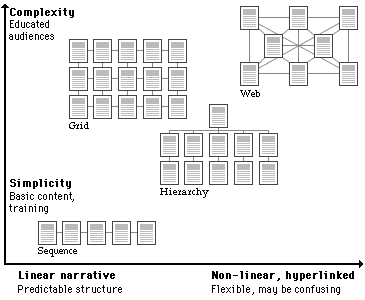
The Yale Style Manual defines four types of site structures for organizing your navigational scheme:

Diagram of site structure alternatives.

1.  Sequence: Use with information that naturally flows as a narrative, time line, or in logical order; may be chronological, a logical series of topics progressing from the general to the specific, or alphabetical.

2.  Grid: Use to correlate variables, such as a time line versus historical information in a number of standard categories such as "events," "technology," "culture," etc; must share a highly uniform structure of topics and subtopics; use with a graphic overview.

3.  Hierarchy: Use to organize complex bodies of information. Most users are familiar with hierarchical diagrams, and find the metaphor easy to understand as a navigational aid.

4.  Web: Use to mimic associative thought and free flow of ideas, where visitors follow their interests in a heuristic, idiosyncratic pattern unique to each person who visits the site; although goal is to fully exploit the Web's power of linkage and association, can just as easily propagate confusion and fuzzy thinking about the interrelationships of your information chunks. (http://www.med.yale.edu/caim/manual)


Do you know what type of site structure this site uses?

Related Topics:
Site Structures
Primary & Secondary Navigation
Menus & Submenus
Clear Navigation
Site Metaphor

Questions? Comments?  Do I practice what I preach? Contact me at afensie@attbi.com.
Organizing Your Web: A Guide to Creating Intuitive Navigation Structure was created by Anne Fensie for IT522 at Bridgewater State College.
Copyright 2002
Last updated October 03, 2006